Read Win at the Kitchen Table (PDF)
How the best HVAC companies close more deals
Over the years of supporting sales teams with hundreds of HVAC contractors on Sales Builder Pro, I've noticed something about the companies that get where they want to go. They rarely have the most talented closers. What they have is a sales process. They know what homeowners are really buying, they prepare before the call, and their consultants run the same sales call the same way every time.
The companies that struggle usually just wing it. Their results swing depending on who happens to be on the call.
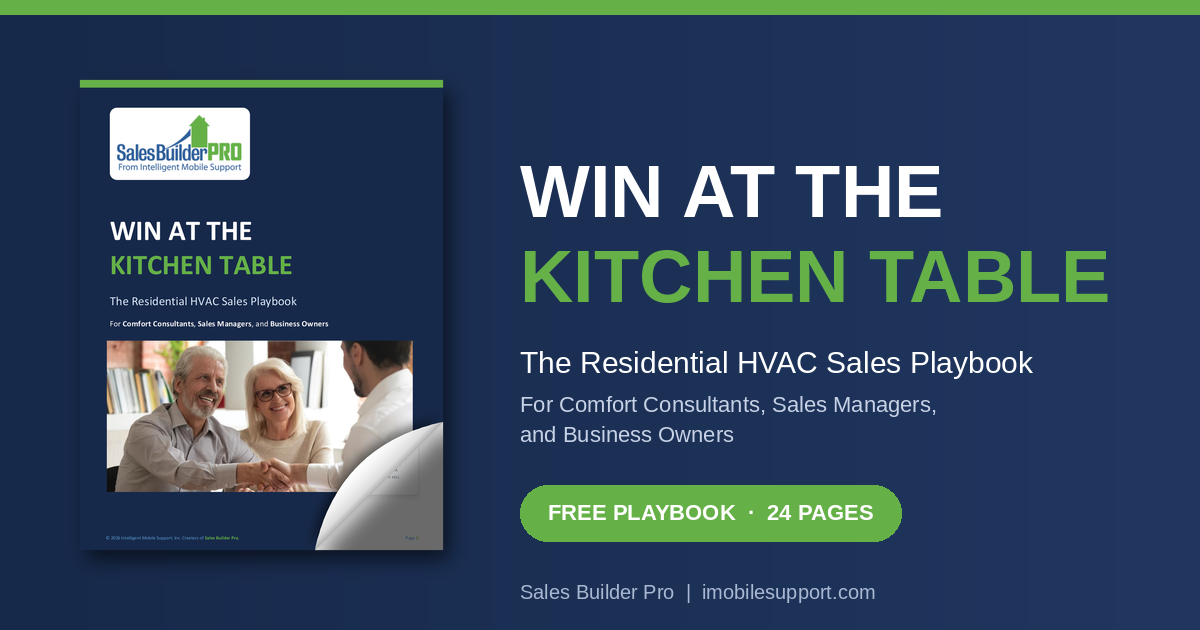
That difference is why we wrote Win at the Kitchen Table: The Residential HVAC Sales Playbook. It's a free, 24-page guide for Comfort Consultants, Sales Managers, and Business Owners, built from what our customers do that works. You can read it right now, no form required, at the link at the end of this post. Here's a preview of what's inside.
Contractors sell equipment. Homeowners buy comfort
Nobody wakes up wanting a heat pump. Homeowners want a master bedroom that finally cools down, utility bills that stop climbing, or a system they can't hear from the couch. Equipment is how you deliver those things; comfort is what they're buying.
Part One of the playbook organizes the seven things homeowners care about into an acronym we admit is a little contrived, but it sticks: COMFORT. Cleaner air, optimal humidity, money saved, airflow, quieter operation, rest, and even temperatures. No homeowner cares about all seven. In a real house, three or four matter, and discovery is how you find out which. That's also why the playbook's first rule is never lead with a spec. A SEER2 rating never made anyone comfortable.
Selling comfort isn't just nicer for the homeowner. Companies that compete on equipment specs compete on price. Companies that document what a family wants, room by room, and propose a solution matched to it are creating value most competitors can't match, and that supports profitable pricing.
Many sales calls are won or lost before you knock
Part Two covers three jobs that require no sales talent at all, just discipline: set profitable prices and discount authority in advance so nobody prices in the driveway; qualify leads with the same questions in the same order so your best hours go to real buyers; and confirm the appointment twice, then share your ETA, so trust starts before the door opens.
One number from that section worth sitting with: evening and weekend calls, when both decision-makers are home, close at a higher rate. Finding out who will be there is the single most useful question on a confirmation call.
The nine-step sales call
Part Three is the heart of the playbook: the sales call itself, from the greeting to the follow-up, in nine steps. Arrival and rapport. Discovery. The job-site walk-through. Proposal preparation. Delivering the proposal at the kitchen table. Answering questions. Asking for the order. Wrap-up. And follow-up, for the buyer who has to think it over.
You probably do most of these already. The point of writing them down is that you can now rate yourself, or your team, at each one. Pick your two strongest and keep sharpening them. Pick one or two weak spots and fix those this season. Trying to overhaul all nine at once is how nothing changes.
Who it's for
We wrote this for three kinds of owners: the one who wants to grow and needs a process that scales past themselves, the one running a family business who wants their evenings back (quotes finished at the customer's table, not yours at ten at night), and the one preparing for an exit who knows a documented sales process is one of the most valuable things a buyer can find.
Whatever "better" means to you, the playbook is free and it's yours. Read it, share it with your team, and let me know what you'd add. We plan to keep improving it.
Read Win at the Kitchen Table (PDF)
John Steidley is the Founder and CEO of Intelligent Mobile Support, the creator of Sales Builder Pro, the in-home sales app for residential HVAC contractors.

John W. Steidley
John is the Founder and CEO of Intelligent Mobile Support, the company behind Sales Builder Pro. A father of three, he gets his biggest kicks from helping and watching his kids, employees, and contractors grow.