
The furnace or AC just died. The homeowner called. You are at the kitchen table with a proposal and a price for a simple replacement sale. This call was well worth the visit. You are well positioned to win. And there is nothing wrong with this picture. But it could be better.
Walk the house with the customer, if possible. What do you see? What do you hear? What can you discover? An office with the space heater under the desk? A bonus room with the door closed all summer? A sunroom the family uses for six weeks a year? A bedroom where one person sleeps under a fan and the other under two blankets? A basement they keep saying they will finish? A garage with a workbench and a portable heater or a giant fan?
Nobody called about those rooms. Nobody will. Homeowners assume the answer is "that's just how the house is," so they never ask. Yet every one of those rooms is a ductless opportunity, and most of them can be solved with one outdoor unit and a head or two.
Here is what we hear from comfort consultants who sell a lot of ductless: the opportunities were always there. What changed was whether they could afford the time to show the homeowner an answer.
In short: most ductless sales start as a furnace or air conditioner replacement call. The comfort consultant who listens for the rooms the central system never reached, then quotes the fix in a few minutes with Ductless Design Tools, wins the replacement on trust and is first in line when the homeowner is ready for ductless.
Twelve rooms, twelve things to listen for
Of course you will never see this in real life, but we've mapped the twelve most common ductless use cases onto one house. Some are classic ductless: a wall unit in an addition, a floor console in a sunroom. Two are not ductless at all: a whole-home air handler in the attic, and a heat pump coil set over the gas furnace for dual fuel. Same outdoor inverter technology, same design tools, different indoor unit.
Hover or tap each number. The room lights up, and below it you will see what the homeowner usually says. That sentence is the point. A comfort consultant does not sell ductless by pitching it. They sell it by hearing "we can only use the sunroom in spring and fall" and knowing that is a floor console and a single-zone outdoor unit.
Explore the use cases
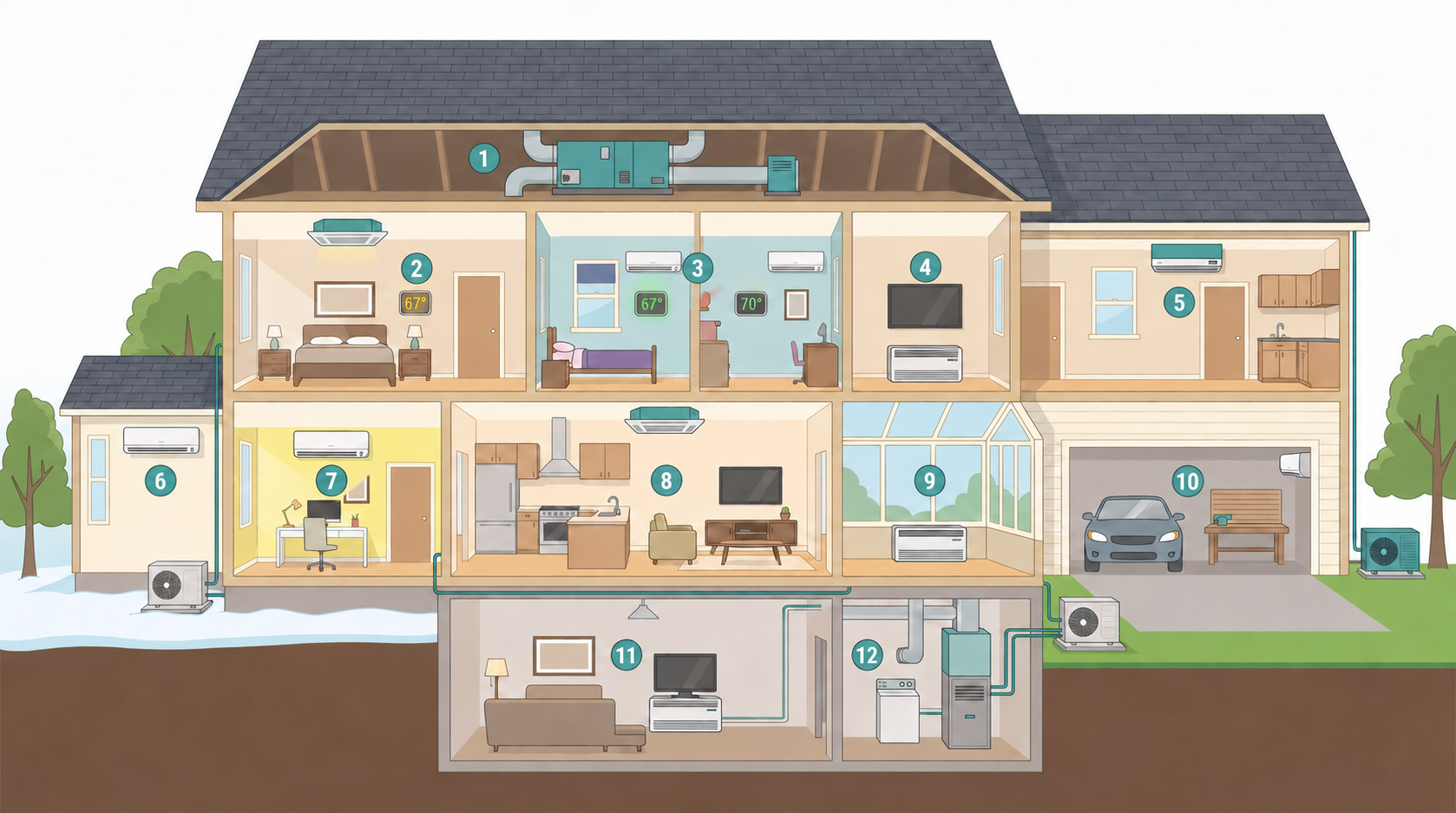
Hover or tap a numbered area to see the use case and what the homeowner usually says. Twelve rooms, twelve reasons a like-for-like replacement leaves money on the table.
Bonus: twenty ductless use cases and what to listen for
- Whole-home air handler in the attic
Our HVAC is on its last legs, how can we lower our electric bills.
- Master bedroom at its own temperature
We like it around 67 degrees to sleep, but then everyone else freezes.
- Bedroom-by-bedroom temperature control
The kids’ rooms are always hot, there is a constant fight over the thermostat.
- Bonus room (a FROG, or finished room over garage, in the Carolinas)
The bonus room is an oven in summer and an icebox in winter.
- In-law suite or Accessory Dwelling Unit (ADU); a casita in the Southwest
My mother is moving in, and she needs her own thermostat.
- Room addition or expansion room
We’re adding on a room, and the contractor says the air can’t reach it.
- Home office
I work from home now, and the office is the worst room in the house.
- Kitchen and great room
It’s hot by the windows and cold by the stairs.
- Sunroom, three-season room, or Florida room
We can only use the sunroom in spring and fall.
- Garage workshop or home gym
I’d like to use the garage year-round, but it’s never been conditioned.
- Finished basement
We finished the basement, but it’s too cold down there.
- Dual fuel: heat pump coil with a gas furnace
Can we keep our furnace for the dead of winter, but cut the gas bill?
- Hot or cold problem room
That room is never the right temperature, no matter what we set the thermostat to.
- Older home with radiators or baseboard and no ducts
We have radiators. The last guy said adding AC means tearing up the plaster.
- Window-unit replacement
We’re tired of the window shakers. Oh, yeah, and I’d like my view back.
- Finished attic or attic bedroom
We finished the attic and it’s unbearable up there in July.
- Detached shop, studio, she-shed, or casita
I built a shop out back and run a space heater all winter.
- Enclosed patio or lanai
We screened in the patio, but nobody can sit out there in August.
- Nursery or guest room
The baby’s room has to stay quiet and steady.
- Spa bathroom remodel
We’re doing a big master bath with a steam shower.
If you can only remember one thing from the map, remember the pattern behind it. Nearly every opportunity surfaces as one of five complaints: a room the central system never reaches, a space that changed use, two people who want different temperatures, a house that was never built for ducts, or an old system and a rising utility bill.
Why these opportunities die on the table
Here is the catch. Almost none of these twelve are a buy-today decision. The furnace or AC replacement is the emergency. The office, the bonus room, the sunroom are all "what if." The homeowner is in think-it-over mode on every one of them, and think-it-over buyers only move when someone puts a real answer in front of them.
A real answer means a design and a number. Which indoor unit, where it mounts, where the outdoor unit sits, how long the line set runs, whether the run is even allowed for that model, and what it costs installed. Built by hand, that is a second visit, a call to the distributor, a spreadsheet, and an evening. For a job the homeowner may not buy this year.
A sales rep thinks, all these"what-ifs," and there is a replacement sale sitting right in front of me. I need to ask for this order. Now. So the rep says, "We could look at ductless for that room sometime." The homeowner nods, and the opportunity is lost for a season or forever. Sales wins over comfort consulting.
Multiply that by every replacement call in a season. The ductless business a contractor is not getting is not lost to a competitor. It is lost to the time it takes to answer the question.
What changes with Ductless Design Tools
Sales Builder Pro is the only HVAC sales tool with built-in ductless design tools, so a comfort consultant can design, price, and close a multi-room ductless job in one visit. The part of that sentence that matters for the what-ifs is "one visit." The design work that used to take an evening happens at the kitchen table while the homeowner watches.
Here is what that looks like on a replacement call. The furnace/AC quote is built. During the walk-through, the homeowner mentions the office and the bonus room. The consultant opens Ductless Design Tools, designs a solution: a wall unit in the office, a floor console in the bonus room, one outdoor unit on the side of the house. The tools check the combination, flag a line-set run that is too long for the model, price the job from the contractor's own price book, and even quote a monthly payment. It takes a few minutes, not a second visit.
Now the proposal has two options on it. The replacement furnace/AC and the two rooms the family complained about. Nobody had to promise to come back.
The homeowner may still choose just the replacement. That's fine. The what-if is no longer a vague idea; it is a page with a picture, a number, and the consultant's name on it.
The payoff comes twice
The first payoff is the replacement sale you came for. A homeowner who watched you listen to their complaints, walk the house, and put a real answer on paper for the room they gave up on does not see a rep selling a furnace/AC. They see a consultant who took their whole house seriously. That is trust, and trust is what closes a replacement against the two other quotes on the counter. The extra care costs a few minutes, and it is the cheapest differentiator in the business.
The second payoff comes later, and it is the one contractors miss over the long run. Think-it-over buyers do eventually buy. The bonus room gets unbearable again next July. Mom moves in. The office becomes permanent. When that day comes, the homeowner already has a proposal in a drawer with a solution and the name of the company that drew it. They do not start a search. They make a call.
That is the quiet math of the twelve rooms. Every what-if you quote is a replacement sale made a little more certain today, and a ductless sale you are first in line for whenever the homeowner is ready.
Start with one room
On your next replacement call, ask one question before you talk about the furnace or AC: "Which room in the house is the least comfortable, and for whom?" Then quote that room alongside the replacement. With Ductless Design Tools, it takes a few minutes, and it changes what the homeowner thinks you came to do.
Want to see how the design tools work at the table? Read the Ductless Design Tools overview, or book a demo and see Sales Builder Pro in action.
Frequently asked questions
What is a ductless opportunity on a replacement call?
Discovering an unstated need or want. They called for the replacement, but what they want and need can be quite different. Common examples are a bonus room, a sunroom, a home office, a finished basement, a garage, or a bedroom that needs its own temperature. Most are solved with one outdoor heat pump and one or more indoor units.
Why don't homeowners ask about these rooms?
They call about a unit that has failed, and they assume the uncomfortable rooms are just how the house is. The opportunity surfaces only when the consultant asks (discovers) which room is least comfortable and for whom.
How long does it take to quote a ductless what-if with Sales Builder Pro?
A few minutes at the kitchen table. Ductless Design Tools lets you recommend an outdoor unit, lay out the lineset run, select a matched indoor unit, price the job, and estimate a monthly payment so you can include a ductless option on the same proposal as the replacement.
Which ductless brands can I quote with Sales Builder Pro?
You can quote any ductless brand with Sales Builder Pro. However, Ductless Design Tools are only available for Mitsubishi Electric Trane, LG, Fujitsu, Lennox Powered by Samsung, Carrier, Bryant, and Midea.
Sales Builder Pro is the tablet-based sales platform that helps residential HVAC contractors win at the kitchen table.

John W. Steidley
John is the Founder and CEO of Intelligent Mobile Support, the company behind Sales Builder Pro. A father of three, he gets his biggest kicks from helping and watching his kids, employees, and contractors grow.